
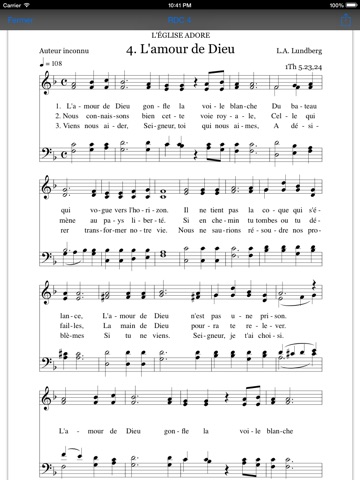
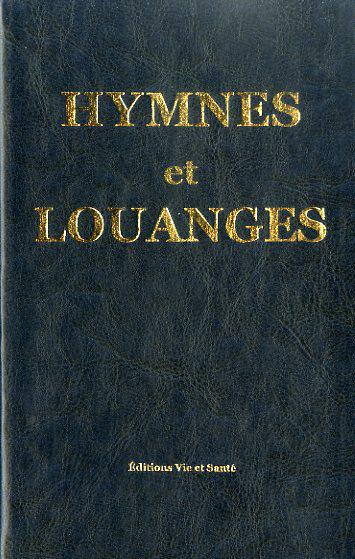
Recueil “hymnes Et Louanges”

The Real Book refers to compilations of lead sheets for jazz standards. It usually refers to the first volume of a series of books transcribed and collated by Berklee College of Music students during the 1970s.[1]
The name is derived from the earlier fake books that were in common use by professionals; those were often more geared to society and dance bands rather than jazz ensembles, and devoted much space to show tunes, novelty tunes, traditional jazz, etc. The first three Real Book volumes, in contrast, contained many bebop and other jazz standards that were likely to be encountered on jazz gigs at the time. For this reason, the books were quickly adopted among jazz players in the 1970s, particularly on the east coast.
The original Real Book volumes, like earlier fake books, were printed without securing copyright releases or paying royalties, and they were thus illegal. These unlicensed books were all sold through informal connections, e.g. for cash in the backs of music stores, and between musicians. In 2004, the Real Book material was acquired by publisher Hal Leonard and licensed for legal sale. Many new volumes were eventually added to the series, and some of the famous errors in the original volumes were corrected. These books also inspired a similar series, offered by the Sher Music Co., called The New Real Book.
The Real Book is published in editions to suit B♭, E♭, F, and C (concert pitch) instruments, as well as bass clef and voice editions ('low' and 'high' voice, with lyrics). Each edition is paginated identically.
History[edit]
51.2k Followers, 498 Following, 235 Posts - See Instagram photos and videos from Melina Kanakaredes (@therealmelinak). From Middle French recueille, recuille welcome, reception, (probably) that which is collected, recueil (French recueil) welcome, reception, literary compilation from recueillir.
Compositions by Steve Swallow, Paul Bley, and Chick Corea are heavily represented in The Real Book with jazz standards and classic jazz compositions. Those were the songs that were played most in Boston in the early 1970s when the book was written.[1] When Swallow was asked about the origin in February 2018, he said the book was written by students at Berklee who wanted to make money. They asked permission to use some of his songs, and he agreed. Swallow asked Bley and Steve Kuhn if they wanted some of their songs included, and they did; so they all contributed lead sheets. Swallow helped briefly with editing.[2]
Then I watched these guys finally get the book together. One of them had a beautiful manuscript that subsequently became classic—it's called the Real Book font, and it imitates with uncanny accuracy his hand. He went on to be a big-time music copyist in Hollywood... The irony is that shortly after the book was put out, some other people realized they could photocopy it and sell it themselves, and the two guys who did all the work and put the book together made a lot less money than they had hoped to because there were imitation Real Books out there almost immediately... The Real Book was imperfect; there were wrong changes throughout it, but it was tremendously more accurate than what existed previously. And also, it was a lot more legible; it was easy to read.'[2]
Only the first volume is the original. The two following volumes of The Real Book were produced. Volume 2 is printed in characteristically 'rough' handwriting and transcription, while the third volume is typeset on a computer. The transcriptions in The Real Book are unlicensed; no royalties are paid to the musicians whose songs appear in the book. Consequently, the book violates copyright and is therefore illegal. In the past, it was usually sold surreptitiously in local music stores, often hidden behind the counter for customers who asked. PDF editions of the book are often available illegally on P2P networks.
The name is most likely a play on words from the common name for these types of song folios: 'fake book'. But it could have been influenced by the Boston alternative weekly newspaper, The Real Paper, started by writers of The Phoenix newspaper in Boston after a labor dispute.
A variety of dates have been attributed to the book. The April 1990 issue of Esquire featured The Real Book in the 'Man at His Best' column by Mark Roman in an article called 'Clef Notes'. He stated, 'I don't know a jazzman who hasn't owned, borrowed, or Xeroxed pages from a Real Book at least once in his career,' and he quoted John F. Voigt, music librarian at Berklee. 'The Real Book came out around 1971.[3] The only material available in print then was crap.'

Another feature surfaced on April 10, 1994, in The New York Times article 'Flying Below the Radar of Copyrights'. Guitarist Bill Wurtzel was quoted as saying, 'Everyone has one, but no one knows where they come from.' The writer of the article, Michael Lydon, said, 'I got mine in 1987 from a bassist who lives in Queens and who attended the Berklee School of Music in Boston; many in jazz circles suspect that students there reproduced the first copies of it in the mid-70s.'[4]
Pat Metheny claims that while teaching at Berklee College of Music from 1973 to 1974, one of his guitar students and one of Gary Burton's vibraphone students (both of whom wish to remain anonymous) invented the idea of assembling the anthology that would form The Real Book. Early editions included several compositions by Metheny as 'Untitled Tune' as they had not yet been recorded and released.[1]
Hal Leonard versions[edit]
In 2004, music publisher Hal Leonard obtained the rights to most of the tunes contained in the original Real Book and published the first legal edition, calling it the Real Book Sixth Edition in tacit acknowledgment of the five previous illegal versions. The cover and binding are identical to the 'old' Real Book, and the books employ a font similar to the handwritten style of the originals although the new editions are more legible. The other main improvements are that most of the editing mistakes have been corrected and every tune has been licensed and the copyright owners are being paid for the use of their intellectual property.
One hundred and thirty-seven tunes are missing in the 6th edition that were in the 5th, while 90 new tunes have been added.[5]
Hal Leonard released The Real Book, Volume II, Second Edition in answer to the Real Book, Volume II. This was followed by The Real Book, Volume III, Second Edition (July 2006), The Real Book, Volume IV (December 2010), The Real Book, Volume V (June 2013), and The Real Book, Volume VI (June 2016). These books contain much of the same material as their counterparts, and in most cases charts from Hal Leonard books are compatible with the Real Book charts. In some cases, compatibility issues occur where corrections have been made to some of the mistakes in the 5th edition charts; in other cases, 6th edition charts may reference changes on better or more authoritative recordings.
Selected editions[edit]
Recueil De Nouvelles
- The Real Book 2nd edition, Hal Leonard (publisher) (2004)
- Volume II OCLC605194191, 60841601
- Volume II, C OCLC213853072
- Volume III OCLC795309725, 787732883, 317729978
- Volume III, E♭OCLC605194255
- The Real Book, 2nd edition, O. Angabe (publisher) (1980) OCLC314155091
- The Real Book, Pacific edition, Real Book Press (1980) OCLC9593108
- The Real Book, 6th edition (2007) OCLC56846058, 189624769, 750243800
Note: The New Real Book, also in 3 volumes, published by Sher Music Co.,[6] is another legal and readily available modern alternative. The collection of tunes in it differs from the original Real Book. This edition offers some of the same songs, with different transcriptions and notation.
- The New Real Book, compiled & edited by Chuck Sher (Charles D. Sher; born 1947) & Sky Evergreen (aka Bob Bauer; né Robert E. Bauer; 1956–1997),[7] Sher Music (publisher) (1988)
- 1st Edition, C & vocal version OCLC311905162
- Volume I
- Volume II
- Volume III ISBN978-1-883217-03-7

Some other music publishers also apply the term Real Book to their own publications — for example, the Associated Board of the Royal Schools of Music publishes The AB Real Book. Alfred Publishing Co. has three real books.
See also[edit]
- Ralph Patt, author of The Vanilla Book of 400 chord progressions for jazz standards
- Chas. H. Hansen Music Corp., pioneer publisher of legitimate fake books
References[edit]
- ^ abcMetheny, Pat. The Pat Metheny Real Book: C instruments (Artist ed.). Milwaukee, Wisconsin: Hal Leonard. ISBN978-1480350595.
- ^ abSchroeder, David (Interviewer) (February 14, 2018). Steve Swallow & John Scofield Interviewed by Dr. David Schroeder, NYU Steinhardt Jazz Studies Director (Motion picture). New York City: NYU Steinhardt Jazz Studies.
- ^Man At His Best: Clef Notes, by Mark B. Roman (born 1962), Esquire, April 1990, Vol. 113 ISSN0194-9535
- ^Pop Music; Flying Below The Radar Of Copyrights, Michael C. Lydon (born 1942), The New York Times, April 10, 1994
- ^'The Real Book Listening Guide · Differences Between the 5th and 6th Editions'. 9 May 2013. Archived from the original on 9 May 2013. Retrieved 2 December 2018.
- ^Sher Music official website, Chuck Sher (Charles D. Sher; born 1947) (proprietor)
- ^Obituary: Evergreen, Sky 'Bob Bauer,' 41, San Francisco, CA,San Francisco Chronicle, June 19, 1997
EUdict (European dictionary) is a collection of online dictionaries for the languages spoken mostly in Europe. These dictionaries are the result of the work of many authors who worked very hard and finally offered their product free of charge on the internet thus making it easier to all of us to communicate with each other. Some of the dictionaries have only a few thousand words, others have more than 320,000. Some of the words may be incorrectly translated or mistyped.
Esperanto is only partially translated. Please help us improve this site by translating its interface.
Total number of language pairs: 492
Total number of translations (in millions): 14.3
Improved: English<>Italian, English<>Portuguese, Spanish>English
Options
There are several ways to use this dictionary. The most common way is by word input (you must know which language the word is in) but you can also use your browser's search box and bookmarklets (or favelets).
Look at the complete list of languages: Available language pairs
There are two Japanese-English (and Japanese-French) dictionaries and one contains Kanji and Kana (Kana in English and French pair due to improved searching). For the same reason the Chinese dictionary contains traditional and simplified Chinese terms on one side and Pinyin and English terms on the other.
Browser integration (Search plugins)
Perhaps the best way to enable dictionary search is through integration into the search field of your browser. To add EUdict alongside Google, Yahoo!, Amazon and other search engines in Mozilla Firefox or Internet Explorer, simply click on link after the title Browser integration, select appropriate language pair and confirm your decision. And you're ready to go; select EUdict from the drop-down list in search field (Firefox) or address bar (IE), input a word and press Enter. In Chrome, first click on a language pair and change the search keyword in the field 'Keyword' to a keyword (eg: 'eudict'). Afterwards, you simply type the chosen keyword in the address bar to start the search in the chosen dictionary.
Bookmarklets
There is a way to enable word translation from any page: Bookmarklets. A bookmarklet is a small JavaScript code stored as a bookmark in your browser.
Tips and tricks
Recueil Synonyme
If you want to type a character which isn't on your keyboard, simply pick it from a list of special characters. If you are unable to add a bookmarklet in Mozilla Firefox according to the instructions above, there is another way; right click on a link and select Bookmark this link… Now you can drag this link from Bookmarks to the Bookmarks Toolbar.
Instead of clicking the Search button, just press Enter. Although EUdict can't translate complete sentences, it can translate several words at once if you separate them with spaces or commas. Sometimes you can find translation results directly from Google by typing: eudict word. If you are searching for a word in Japanese (Kanji) dictionary and not receiving any results, try without Kana (term in brackets). If you are searching for a word in the Chinese dictionary and not receiving any results, try without Pinyin (term in brackets). Disable spellchecking in Firefox by going to Tools → Options → Advanced → Check my spelling as I type. Why not add a EUdict search form to your web site? Form
Credits
My name is Tomislav Kuzmic, I live in Croatia and this site is my personal project. I am responsible for the concept, design, programming and development. I do this in my spare time. To contact me for any reason please send me an email to tkuzmic at gmail dot com. Let me take this chance to thank all who contributed to the making of these dictionaries and improving the site's quality:
Recueil Dalloz
- Goran Igaly – author of the initial English-Croatian database
- Natali Kralj – author of the Dutch-Croatian dictionary
- Jim Breen – author of the Japanese-English dictionary
- Besiki Sisauri – author of the English-Georgian dictionary
- Giorgi Chavchanidze – author of the several Georgian dictionaries
- Jerzy Kazojć – for excellent dictionaries collection
- Rajesh – for help with English-Tamil and German-Tamil dictionary
- Chinese-German dictionary adapted from: 'The free Chinese-German dictionary'
- Grazio Falzon – author of the English-Maltese dictionary
- András Tuna – for smart suggestions about improving this site
- Interface translation: Tomislav Kuzmić (Croatian), Vasudevan Tirumurti, Fahim Razick (Tamil), Matti Tapanainen (Finnish), Ebru Bağlan (Turkish), Arsene Ionuț, Cristina Crisan (Romanian), Daiva Macijauskė (Lithuanian), Tetiana M. (Ukrainian), András Tuna (Hungarian), Jakob Lautrup Nysom (Danish), Andre Abdullin, Elena Zvaritch (Russian), Catherine Györvàry (French), Gab M., Klaus Röthig (Portuguese), Marcin Orzełek (Polish), Stefanija Madzoska, Daniel Matrakoski (Macedonian), Selina Lüdecke, P. H. Claus (German), Vangelis Katsoulas (Greek), Roberto Marchesi (Italian), Robin van der Vliet (Esperanto), Reno Rake (Indonesian), Nahuel Rodríguez (Spanish), Gao Pan (Chinese), Hoài Sang Lăng (Vietnamese)
Recueil Chants Pour Enfants
EUdict is online since May 9, 2005 and English<>Croatian dictionary on tkuzmic.com since June 16, 2003.